


Source: nobelprize.org
The Royal Swedish Academy of Sciences has announced the names of the winners of the Nobel Prize in Physics for the year 2023.
Nobel Prize 2023 in Physics winners
1. Prof. Pierre Agostini, The Ohio State University, Columbus, USA
2. Prof. Ferenc Krausz, Max Planck Institute of Quantum Optics and Ludwig Maximilian University of Munich, Germany
3. Prof. Anne L’Huillier, Lund University, Sweden
“For experimental methods that generate attosecond pulses of light for the study of electron dynamics in matter.”
What is an attosecond pulse?
The light pulse that lasts in attoseconds is called an attosecond pulse. Attosecond is a unit of time and is equivalent to one quintillionth of a second (1 divided by 10 to the power 18). To put the concept of “attoseconds” into perspective, imagine dividing one second into units of attoseconds. This division is equivalent to dividing the entire lifespan of the universe, which is estimated to be 13.8 billion years, into individual seconds. The physics associated with attosecond timescale phenomena is often referred to as attosecond physics.
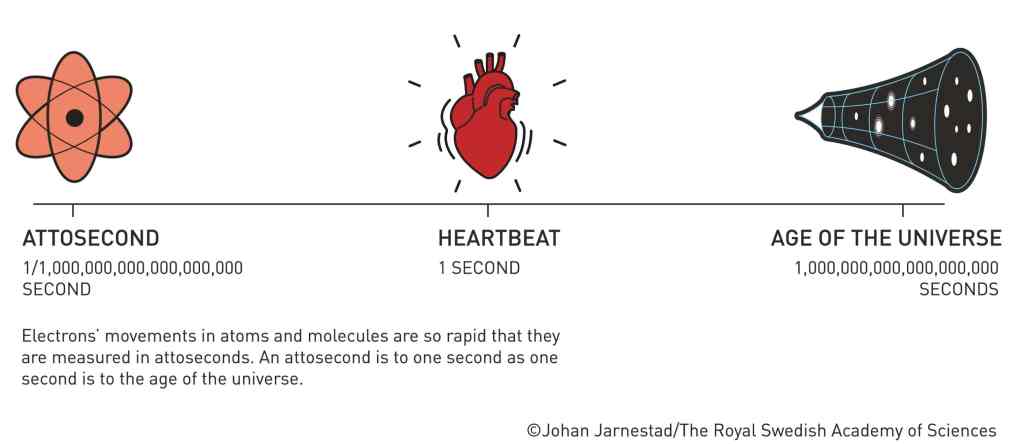
Source: nobelprize.org
The contribution of the Nobel laureates to attoseccond Physics
Let’s understand the problem first, “why do we need attoseconds pulses?” We human being have limitations in ability to perceive a rapidly changing visual information. It takes nearly 1/10 second to the retina to register a piece of information and if the information changes without this much exposure time, it will not be registered and we will have a blurry vision. Very quickly changing information cannot be perceived by human eyes. For instance, a hummingbird can flap its wing 80 times in one second and we can perceive only the whirling sound and blurred movement. To solve this problem, we need technological support, e.g., advanced photography that can capture the quickly changing wing movement, where the exposure time required for the camera to record the event is shorter than a wingbeat movement. The same principle is applied to measure every rapidly changing system. If we wish to record some event, the measurement device response time must be faster than the changes in the system undergoing measurement.
In particular, the movements of atoms in molecules have the timescale in femtoseconds (one quadrillionth of a second or 1 divided by 10 to the power 15) and hence dynamics of the atoms can be observed through the ultrashort or femtosecond pulses. However, it is mostly the nuclei that have the movements in the femtosecond timescales. In the case of electrons, the interactions happen over sub-femtoseconds timescales, in fact, attoseconds. Therefore, to visualize the whole dynamics of electrons inside atoms and molecules, we need attoseconds pulses.
The Nobel laureates for this year have demonstrated the experimental methods for generating the attosecond pulses of light to capture the dynamics of the electron in atoms and molecules.
For a long time, it was thought that the femtosecond pulse is the limit of short pulse generation and we cannot surpass this limit. However, that is not the case anymore.
In 1987, Anne L’Huillier discovered that when infrared light passes through a noble gas, it generates harmonics of the light. Each harmonics is a light wave with a certain number of cycles. The harmonics are the result of the interaction of infrared light with the atoms. The electrons oscillate in the electric field of the laser pulse and gain additional energy which is released in the form of harmonics when they recombine with the parent atom. This discovery led the foundation for the explorations of the high-harmonics generation (HHG) for the attoseconds pulse generation.
In 2001, Prof. Pierre Agostini succeeded in generation of series of ultrashort pulses having 250 attoseconds pulsewidth. At the same time, Prof. Ferenc Krausz with different experiments isolated a single pulse of 650 attoseconds.
The experiments performed by these eminent researchers have provided invaluable insights into the behaviour of electrons and opened up new avenues for understanding and controlling electron mechanisms. With implications in fields such as electronics and medical diagnostics, their research works have the potential to drive advancements and innovations in various scientific disciplines.
“We can now open the door to the world of electrons. Attosecond physics gives us the opportunity to understand mechanisms that are governed by electrons. The next step will be utilizing them,” says Eva Olsson, Chair of the Nobel Committee for Physics.
Prof. Gopal Dixit from IIT Bombay, one of the India’s leading scientist in the field of Attosecond Physics and whose work has been cited several times by the Nobel laureates of Physics 2023, said, ‘Attosecond Physics can advance the biomedical diagnosis for the detection of Cancer at early stages and will improve processing speed of electronic devices by introducing light-driven PetaHertz electronics. Also, this technology will bring quantum technologies into reality at ambient conditions.”
What are the possible applications of the attosecond pulses?
The attosecond pulses can be used for the following applications.
* The localization and control of the electrons in molecules to understand the chemical reactions.
* To switch the conductivity of the material from insulator to conductor by exciting the bound electrons which have potential applications electronics.
* Biological diagnosis of the cancer cells, where small changes in the blood plasma can be identified using attosecond spectroscopy.
How much is the Nobel Prize amount?
11 million Swedish kronor (~ 9,93,675 USD/ 8,27,39,242 INR).
How will the prize be distributed?
The prize will be equally shared among them.
For more details visit: nobelprize.org
Discover more from New Wave Particle
Subscribe to get the latest posts sent to your email.