

The plasma dynamics investigations indicate the existence of a lunar crustal magnetic field.
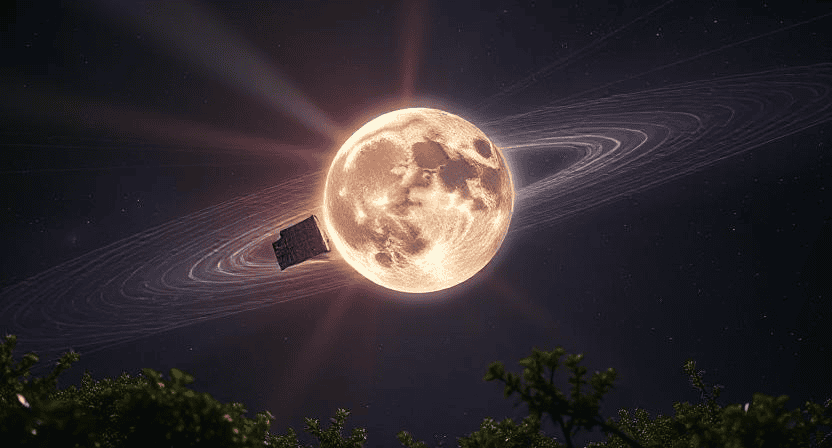
Illustration of Chandrayaan 2 orbiting around the moon.
Chandrayaan-3 Offers Groundbreaking Findings on Water Ice Retention on the Moon
A new study based on radio signal analysis of the Chandrayaan-2 (CH-2) orbiter, has yielded surprising information regarding the Moon’s ionosphere. The study reveals that the moon’s ionosphere exhibits unexpectedly high electron densities when it enters the Earth’s geomagnetic tail, which could be explained only by the presence of a lunar crustal magnetic field.
The study, conducted at Space Physics Laboratory (SPL) of Vikram Sarabhai Space Centre (VSSC) of ISRO, is published in ‘The Astrophysical Journal Letters’ having the title ‘Lunar Ionosphere in the Geotail Region as Observed by Chandrayaan-2 Orbiter Using Two-way Radio Occultation Measurements’ [1]. The research was led by Dr. Keshav Ram Tripathi, who is currently a JSPS International Research Fellow at The University of Tokyo, Japan.
Let’s break it down into pieces so that we can understand the results and their significance.
Fact 1: Previous studies conducted using radio occultation (RO) measurements indicate a significant presence of plasma in the moon’s ionosphere. However, the electron density differs between the sunlit portion and the wake region (where sunlight does not reach).
Fact 2: The Earth has a magnetic field bubble that extends far into space. The interaction between the Earth’s magnetosphere and the solar wind, which is a continuous stream of charged particles emitted by the sun, creates a long and extended region of the Earth’s magnetic field that stretches far into space on the opposite side of the sun. This extended region of the Earth’s magnetic field is called the geomagnetic tail.
You might be wondersing that this study is about moon and why I am talking about earth’s geomagnetic tail. The reason is that for about 15% of its orbital time, the moon travels through Earth’s magnetotail. Thus, moon’s ionosphere is shielded from direct solar wind during this time. Now the situation gets interesting!! At this time when the moon is in Earth’s magnetic tail, what effect will it have on plasma density? The scientist answered the question in this study.
The scientist calculated the first electron density profile of the Lunar ionosphere when the Moon is inside the geomagnetic tail region. This observation utilized S-band radio signals and telemetry telecommand in a two-way radio occultation experiment from Chandrayaan-2 (CH-2) in Moon orbit. The radio signals were tracked using an 18 m diameter antenna at the Indian Deep Space Network (IDSN). The IDSN served as an active source for generating and receiving the radio signal, whereas onboard oscillator on CH-2 was used as a passive receiver and transmitter. The radio signal sent passed twice through the lunar plasma medium before it arrived at the receiver end.
The study found a high electron density of approximately ∼2.5 × 10⁴ per cm−3 close to the surface of the Moon. Scientist did three-dimensional lunar ionospheric model simulations (developed at SPL-VSSC), which suggest that to achieve such high plasma density, the plasma has to be in photochemical equilibrium, as can be achieved in the geomagnetic tail only in the presence of lunar crustal magnetic fields. Without the existence of the lunar crustal magnetic field, the plasma could have diffused away, which would result in a lower density of the plasma than reported in the study.
This finding of the presence of the lunar crustal magnetic field is a very big achievement, as the future lunar exploration mission will be directly affected by this.
“Our results provide the first direct evidence of the influence of Earth’s magnetotail on the lunar ionosphere, which has not been observed before with such precision”, said by Dr. Tripathi, the lead author of the study.
Implications for Future Lunar Missions
Understanding the plasma environment of the Moon is significant for future lunar missions, robotic missions, and human spaceflight. High plasma densities can impact: Radio communications, which can interfere with spacecraft signals. Surface charging effects, which can impact instruments and lunar habitats. Lunar dust interactions, which are significant for landers and rovers operating in the vicinity of magnetic anomalies.
These findings will inform space agencies in planning future lunar missions and habitats, especially in regions affected by crustal magnetic fields. With more nations gearing up for lunar exploration, ISRO’s ongoing research through Chandrayaan-2 is proving invaluable to further develop our knowledge of the Moon’s intricate plasma environment.
This study is another breakthrough in lunar science that reinforces India’s commitment to global space research.
- Tripathi, Keshav R., R. K. Choudhary, and K. M. Ambili. “Lunar Ionosphere in the Geotail Region as Observed by Chandrayaan-2 Orbiter Using Two-way Radio Occultation Measurements.” The Astrophysical Journal Letters 980, no. 2 (2025): L41.
To get the latest update, subscribe
Discover more from New Wave Particle
Subscribe to get the latest posts sent to your email.