

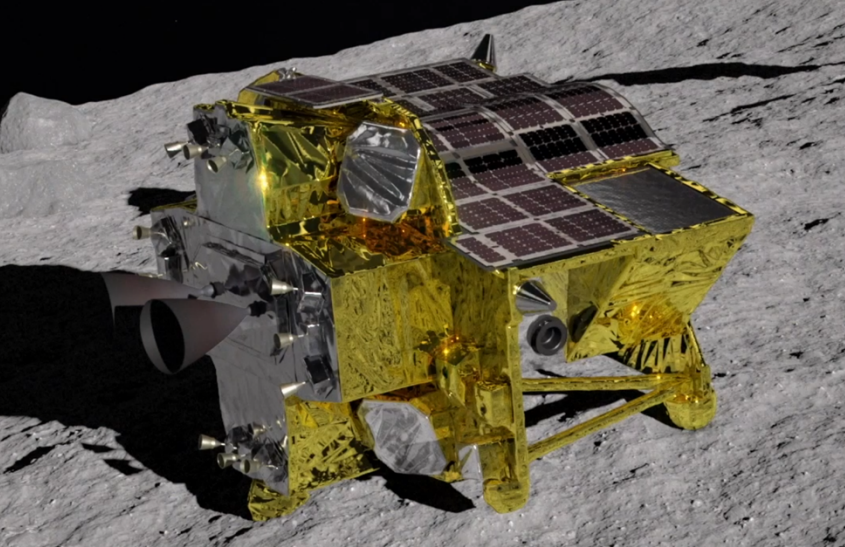
SLIM (Credit: JAXA)
On September 7, 2023, at 8:42:11 am (JST), the Japan Aerospace Exploration Agency (JAXA) launched a lunar lander named SLIM using H-IIA launch vehicle No. 47. The successful landing of India’s Chandrayaan 3 lander Vikram on the Moon’s south pole has given hope for accelerated exploration of the moon. SLIM will make another milestone by attempting to land near the crater on an inclined surface, which has not been done before but is very important for future missions and exploration of terrestrial bodies.
In this article, we will learn what SLIM is, what is the objective of the mission, what experiments are to be conducted using SLIM and why this mission is important not only for Japan but for the whole world.
What is SLIM?
SLIM stands for ‘Smart Lander for Investigating Moon’ developed by JAXA. SLIM has a size of 2.4m x 1.7m x 2.7m, dry mass of 200 kg and a very irregular shape as shown in Image on the top. SLIM is powered by Lithium Ion cell and highly efficient thin film sheets of triple junction solar cell. SLIM has 5 touchdown legs with Aluminum lattice features on it (manufactured by 3D printing), which will work like shock absorbers during the impact with lunar surface. The SLIM will use an ‘Integrated spacecraft control system’ to perform all the computation task to control it and S-Band Transponder (STRX) to communicate with the stations on Earth.
What is the Aim of the SLIM?
SLIM will attempt to contribute to future lunar and planetary exploration missions by accomplishing the following objectives.
- Demonstrating high precision landing on the lunar surface with the landing accuracy of nearly 100 meter.
- Realizing a lightweight lunar and planetary probe unit for accelerated lunar and planetary explanatory missions.
The landing of SLIM
SLIM is expected to land near SHIOLI Crater, which is located in a low-altitude region on the Moon called the “Sea of Nectar”. The slope of the area around the landing site is approximately 15°. Landing on inclined surfaces is very important for many future missions globally and hence the pinpoint landing capability of SLIM will have high impact on future lunar and planetary interpretation missions.
The SLIM will land in the following manner: First, ‘Vision-Based Navigation’ integrated into the SLIM will help measure its position and correct it. Second, the landing radar will provide accurate altitude and approach velocity relative to the lunar surface, which will then be integrated into the guidance and control system, and third, during the final approach autonomous image based obstacle detection and avoidance will be performed for the safe landing. Before landing, it will stabilize itself at zero relative velocity and hover for some time and then it will have a forward inclination. The main landing gear will touch the ground first and then SLIM will rotate forward to stabilize on rest four 3D printed shock absorbing legs towards the inclined surface.

Credit: JAXA
What SLIM will do on the Lunar surface?
SLIM is equipped with the following payloads to perform its duties after landing.
1. Multi-Band Spectral Camera: To investigate the elemental composition of the surrounding rocks, which are expected to form from the lunar mantle. One of the main objectives of landing near craters was to find and investigate the lunar mantle, and hence landing on an inclined surface becomes mandatory.
2. Lunar Excursion Vehicle: It will be ejected from the SLIM just before the landing and will do the photo imaging.
3. Laser Retroreflector Array: It consists of a series of mirrors, which reflect the laser beam back to their point of origin. Earth-based laser-ranging stations can measure the time it takes for the laser to travel to the retroreflector and back and then using the speed of the laser light (3×10⁸ m/s), we can calculate the distance from that station to the retroreflector. Thus, by measuring the distance and collecting data at constant intervals from different stations, we can accurately define the orbit of the spacecraft or satellite where the retroreflector is placed, which is continuously rotating. The laser retroreflector array will help in ascertaining the exact position of the lander and the orbit of the moon.
It may take approximately 3 to 4 months to reach lunar orbit and 4 to 6 months to the time of landing (from launch time).
Overall, the successful landing of SLIM on the inclined surface of the Moon will help in designing future lightweight landers to explore terrestrial bodies awaiting our arrival.
Cheers!!
We will keep updating it here!! stay tuned!!
Discover more from New Wave Particle
Subscribe to get the latest posts sent to your email.