

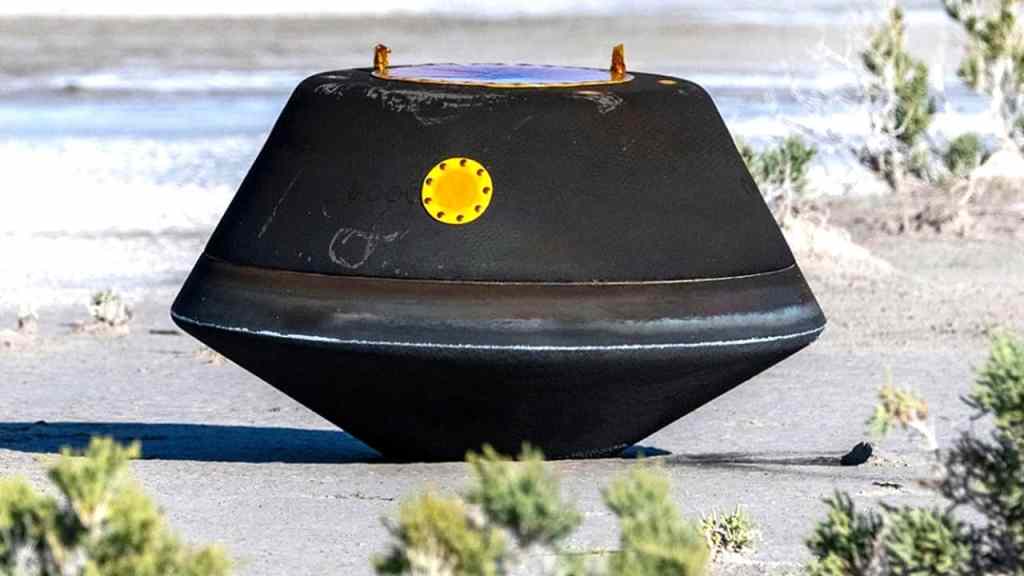
The OSIRIS-REx sample capsule containing pieces of the asteroid Bennu, landed safely in the Utah desert on 24 September. Credit: Keegan Barber/NASA
NASA’s OSIRIS-REx (Origins, Spectral Interpretation, Resource Identification and Security – Regolith Explorer) mission successfully returned a saucer-shaped capsule containing rocks and dust from the asteroid Bennu to Earth at 10:52 a.m. EDT. The capsule parachuted down in the Utah desert and is immediately transported to the a cleanroom and is kept in continuous flow of nitrogen. Nitrogen is a non reactive gas and will not have any impact on the sample as such but the continuous flow of nitrogen will remove the contaminations from earth.
This is the first time NASA has brought back samples from this type of celestial object, and it is the largest amount of material ever collected from an asteroid. The samples will be studied to learn more about the origins of the Solar System and may contain organic compounds that could provide insights into the building blocks of life. The pristine samples will be analyzed using cutting-edge laboratory techniques to understand their composition and geology. The results of the analysis will be unveiled in a press conference scheduled for October 11th.
“With OSIRIS-REx, Psyche launch in a couple of weeks, DART’s one year anniversary, and Lucy’s first asteroid approach in November, Asteroid Autumn is in full swing. These missions prove once again that NASA does big things. Things that inspire us and unite us. Things that show nothing is beyond our reach when we work together,” said NASA Administrator Bill Nelson.
Bannu’s sample, estimates nearly 250 gram, will be transported to NASA’s Johnson Space Center in Houston on 25th Sep by aircraft in unopened canister. The scieentist will then open the canister. extract and weigh the sample and after making the inventory, the distribution of the pieces of the sample will take place to the worldwide scientist for the research purpose.
“Successfully delivering samples from Bennu to Earth is a triumph of collaborative ingenuity and a testament to what we can accomplish when we unite with a common purpose. But let’s not forget – while this may feel like the end of an incredible chapter, it’s truly just the beginning of another. We now have the unprecedented opportunity to analyze these samples and delve deeper into the secrets of our solar system,” said Dante Lauretta, principal investigator for OSIRIS-REx at the University of Arizona.
It took nearly 7 years to complete this mission and during this the spacecraft traveled 3.9-billion-mile journey through space. The rocks from Bannu might help us in understanding the origin of life on earth.
Discover more from New Wave Particle
Subscribe to get the latest posts sent to your email.